

As a small business, it’s a must to have an online presence nowadays. But having a website is only half the battle. You also have to make sure that people find you online. And that’s where your search engine optimisation (SEO) has come in over the last few years. Small business SEO in the age of AI search, however, is a whole new ball game!
Whether people are looking specifically for your opening hours or generally for a company like yours in their local area, optimising your website for search engines and AI search can make a huge difference to your bottom line.
SEO and AI search
Search is evolving with AI-powered tools that summarise information and answer questions directly. That doesn’t replace SEO – if anything, it makes clear, well-structured and authoritative content even more important, because AI relies on it to show relevant businesses to the right people.
By optimising your website and content, you increase the chances that potential clients will discover your business, whether through traditional search results or AI-driven answers.
Here are a few tips to get you started with your small business SEO and make your company website more visible to your ideal clients – in both online and AI searches.
Your small business SEO in the age of AI Search
1. Content

Search engines like Google love websites that generate new content on a regular basis. It shows them you’re an active business and that it’s worth sending their bots more often to check if there’s anything new for them to index.
The same goes for your web visitors because regularly changing content gives them a reason to come back. And that’s great for customer loyalty and repeat business.
It doesn’t mean you need to overhaul your entire content every time. But a business evolves constantly – from new staff members to new products – and your website should reflect that.
So make sure your website is kept up-to-date and be mindful of the details as well: Nothing makes you wonder more if a company is still active than a website with a copyright from 2019.
A great way to produce new content for visitors and search engines alike is a blog. It helps you attract traffic to your website which Google and potential clients alike take as a sign that you have something useful to say.
2. Keywords

But for search engines like Google to show your website in their search results – and ideally, on the first page – you have to know what your potential clients are searching for. And for that, you need to know your target group.
So ask yourself (and your potential clients): What are they looking for? What do they type into their online search when they are looking for a small business like yours?
You can also set up Google’s Search Console for your website. This shows you what keywords people have searched for who have visited your site in the past.
Take these search terms – or keywords – and make them the backbone of your web content: Headlines, body text, links, blog topics, images – everything should reflect what your audience is looking for.
This makes it a lot easier for search engines to spot what your website is about and show it in relevant searches.
Find out how to define the right keywords for your small business.
3. Meta tags
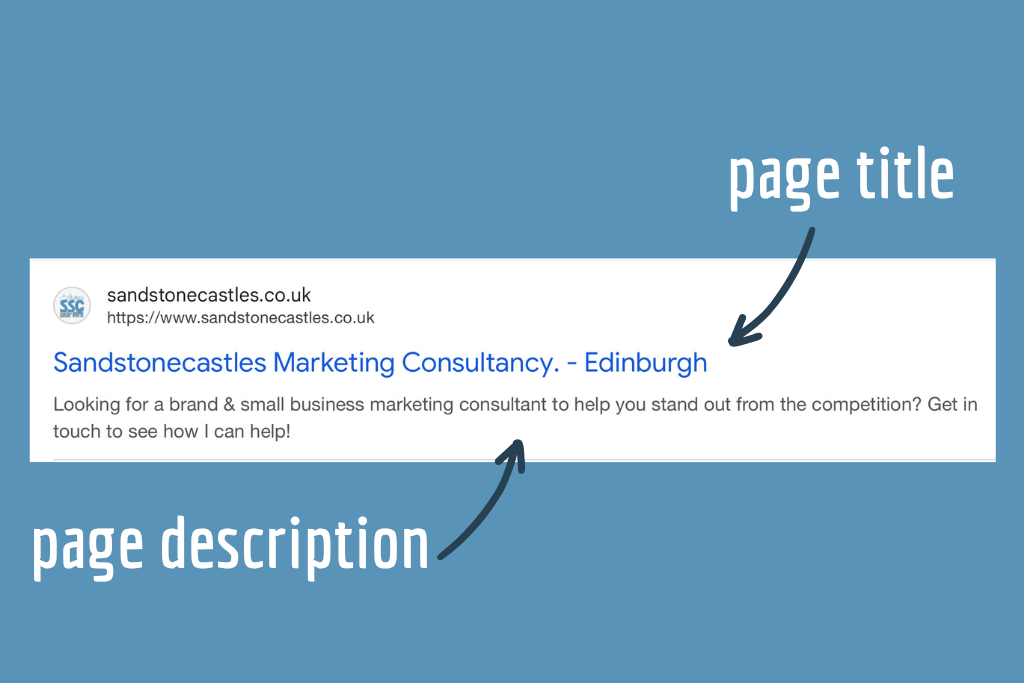
Everybody knows Google’s search results (or SERP, which stands for search engine results page). Each result looks the same: There’s the URL at the top, the page title (in blue) and the page description (in grey) at the bottom. And that is all you have to convince people that your page is worth looking at.
To use this for your small business SEO, consider the title and description as a very short elevator pitch. Make sure your readers learn your company name and see the keywords they were looking for as these will be bold in the search results.
But more importantly: Keep it short & simple. Google will only display a certain number of characters in both the page title and description before they get truncated. How many depends on the screen size or device people are using, e.g. desktop or smartphone. To be on the safe side keep the title to around 60 characters and the description to 150.
Keywords, page title and description are set up for every single page of your website, so make sure you use them wisely.
4. SEO checks in the age of AI search
There are also some technical things that are important for your small business SEO. To get a quick check-up for the basics, use the free online services that are available, e.g. SEO Analyzer or SEOptimer.
These free tools deliver a very simple but helpful report and show what you can change to improve your website’s performance.
And don’t panic if you don’t “speak SEO”! If you have a web developer working on your site, then simply send the results to them and ask for suggestions. And, if not, there are plenty of SEO specialists out there you can contact for advice. It’s always better to link up with a professional than struggle alone when it comes to an area that isn’t your expertise, especially for small business SEO in the age of AI search.
5. Optimise for AI search
It is becoming really crucial to optimise your content not only for basic SEO but for AI search too. If you’re already working hard on your SEO, you are off to a good start here. But there are extra steps to take to increase your chances of appearing in AI results and in.
Once again, if you have a web developer or copywriter working on your website, this is something you can hand over to them! But if you are working on your online presence alone, a few things to consider here are:
- Make sure your content dives deep. AI search is looking for in-depth, meaningful responses to queries. So, don’t keep it at a surface level. If you’re exploring a topic in a blog post, figure out how to fully answer a number of FAQs, rather than keeping things vague.
- Think about your content structure. You want to make this as easy to read as possible. Things like clear headings and subheadings, lists, tables and bullet points can make a big difference here.
- Take care of the technical side of SEO. It sounds obvious but things like ensuring your website is mobile-friendly, your page speed isn’t lagging and your site security is up to date can be a huge help in improving your position for AI search.
AI search optimisation is likely to become more and more important over time, so this is one to keep an eye on and make sure you regularly explore any changes to.
6. Links

Google reads your popularity by the number of websites that link to yours. So make sure you are featured on all relevant online directories with a link to your website.
The same goes for your Social Media pages: Link to your website and post links to specific products, offers and blog posts on a regular basis.
You can also have a page on your website with links to suppliers, complementary service providers and literature for further information as a service for your clients. And don’t forget to ask if the featured businesses, authors, blogs and forums are happy to return the favour.
Another thing is to interlink content on your own website. For example, show relevant blog posts on your product page or link to your price overview from your services page.
It makes the site easier to navigate for people (and Google loves what people love). It also makes it easier for Google to crawl your site.
7. Google My Business
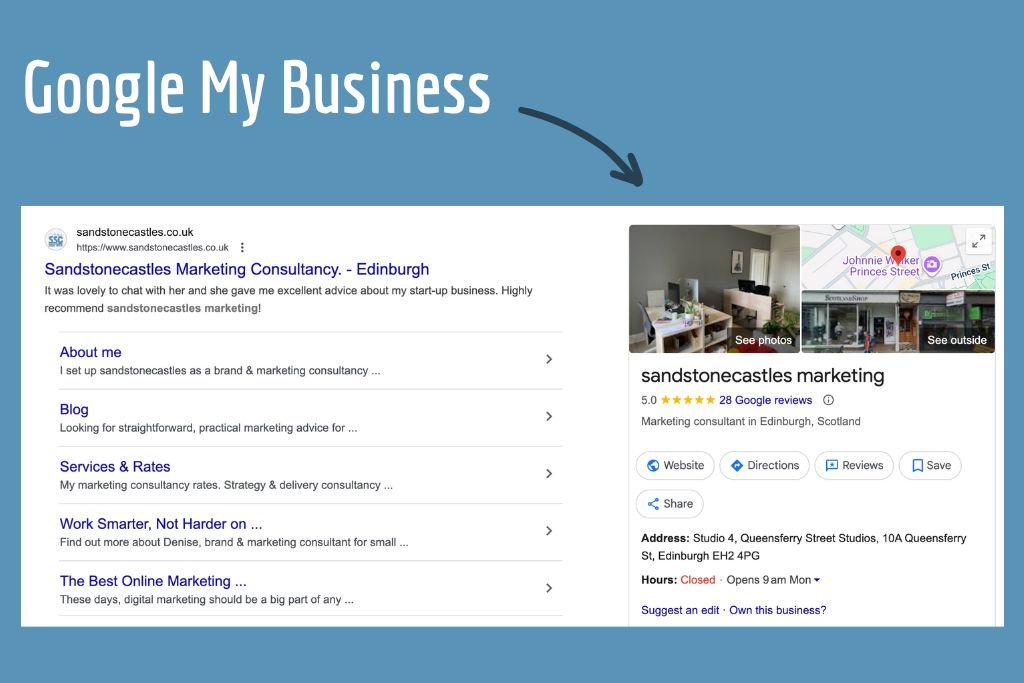
Over the years, Google has created more and more opportunities for businesses to be featured in their search results. One of them is their business listing service, Google My Business. Still, when it comes to small business SEO in the age of AI search, this is really important.
It basically features your business not just in the search results, but also in a separate box with further information about your business.
It also, quite literally, puts you on the map as people can find your business in Google Maps with the help of your listing as well.
Depending on what information you give Google, potential clients can see:
- a short description of your business
- photos
- reviews
- your address & location
- directions
- contact details
- opening hours
This is also where clients can review your products or services and see how others have rated your small business.
Not sure how to use customer reviews to boost your business? Find out how to maximise the impact of that feedback here!
Rinse, wash and repeat
Optimising your company website for search engines is a continuous task. Google changes the way it rates and ranks websites all the time and people’s behaviour changes as well as the recent surge in AI searches has shown.
A few years ago, mobile search was not really relevant to your web design or SEO. These days, Google starts indexing your mobile website first, your desktop version second. And with the introduction of AI search, there is more to consider every day!
So make sure to keep your website and SEO up-to-date and monitor the results. If you’re starting to get a lot of traffic for the wrong keywords, adapt your content accordingly.
If your web traffic through Google has died down, check if Google flags anything on your site or if a competitor is “out-ranking” you for your core keywords. By keeping on top of all of this, you’re giving your website its best chance to attract the customers you most want.
Small business SEO in the age of AI search will always be a bit of a work in progress. But if you follow this guide, you’ll be off to a really strong start.
FURTHER READING
If you are interested in reading more about this topic, have a look at these:
Long Term & Short Term Marketing Tactics – How to get the Right Mix
Keywords for Beginners: What They Do & How to Use Them
4 Steps to a Successful Web Copy
How to Declutter Your Website for Quick, Easy Conversions


