

In my work, I talk a lot about the customer journey. But what actually is it, and why does it matter for your small business?
Using the customer journey in your marketing takes the guesswork out of your content creation. No more staring at a blank screen, wondering what to post or write.
It maps out what your customers are going through, from the point they first become a potential client all the way through to becoming a loyal one. And that tells you what they’re looking for at every stage, and how to get their attention at exactly the right moment.
In short, the customer journey is the backbone of good marketing – and especially content-led, customer-focused marketing, where everything you put out is built around what your ideal clients want and need.
So let’s look at what it looks like in practice, and how mapping it out makes your content easier to plan and more effective when it lands.
Contents:
What is the customer journey?
How to make the most of your customer journey
How does this extended customer journey work?
Generating content ideas
Your overall content strategy
What is the customer journey?

First of all, a potential customer or client is anybody who fits your definition of an ideal client. So, before exploring the journey itself, make sure you are clear on who that is for your business as part of your overall brand strategy.
Once you’re clear on that, you can start mapping their customer journey – think of it as tracking every stage a potential client goes through.
It helps you explore their challenges and goals and the questions and decisions they encounter along the way. These insights are a great source of content, talking points and topics you can use for your marketing.
So what does that look like? Traditionally, the customer journey is often shown as something like this:

Here, the customer journey is split into five distinct phases, starting with the “Discovery Phase” where your potential client starts to look for a solution to the problem you can help them solve.
This is followed by them making a shortlist of options, converting to a paying customer, coming back for more and recommending you to other people.
I am not a big fan of the traditional labels for the customer journey, so I always replace them with these for clarity:

But labels aside, I think the traditional customer journey has a bigger problem.
How to make the most of your customer journey
Think about it: the traditional customer journey starts at the trigger point – when someone’s ready to buy – and maps out everything from there. Which means your marketing only ever targets people who’ve already reached that point, or who are already customers, when your audience could be much bigger.
Because that trigger point doesn’t appear overnight. It builds up gradually, and before it forces them to act, people experience smaller niggles and bumps along the way – ones that might not be worth acting on yet, or that have a relatively easy solution.
Those challenges probably aren’t what your business is built to solve (though they can be useful for entry-level products or services). But they’re a great source of content – a way to share your expertise and be helpful before someone is ready to buy.
Reaching your ideal clients before they hit that trigger point builds awareness, trust and credibility – well before they start comparing you to the competition.
Which is why I always work with an extended version of the customer journey:
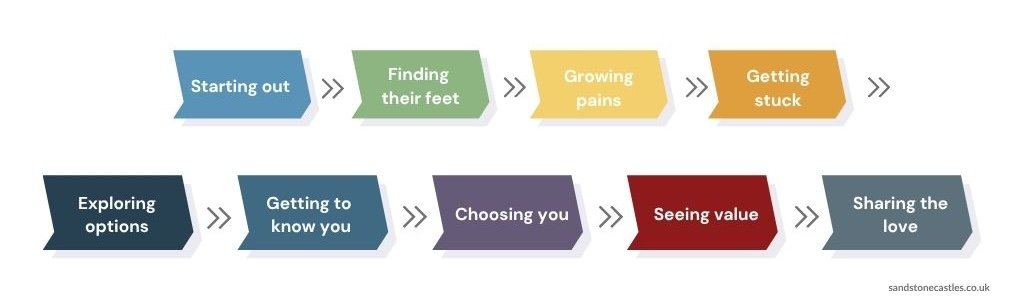
By starting the customer journey earlier – before someone’s even looking for you or your competition – you can reach your ideal clients much sooner. You’re not just there to help once they’ve reached that trigger point, but you’re already a trusted expert by the time they do.
Here’s where another key benefit of extending the customer journey comes into play: Your competition.
If you target your ideal clients at the trigger stage, you often only think of how you can set yourself apart from your direct competitors, people who offer the same service or product as yours.
But that ignores the competitive alternatives that their ideal clients can choose from at both earlier stages and the trigger stage. These are businesses that solve the same problem through a different product or service.
Let’s have a look at what this all means.
How does this extended customer journey work?

Let’s use the example of a Personal Trainer who came to fitness later in life – you’ll recognise them from my Brand Strategy and Brand Messaging posts.
They started their business to help people tackle the same barriers they faced and show them that an active lifestyle is possible at any age. Rather than helping already-fit clients to chase performance goals, they focus on beginners or people returning after a lengthy hiatus.
Traditionally, our personal trainer would only think about what makes them unique from other PTs and stop there. But thinking about the competitive alternatives that their potential customers can choose from, they might also consider:
- Regular walking on their own or with friends.
- Following exercise videos on YouTube.
- Using an app like Couch to 5k.
- Joining a gym to work out alone.
- Signing up for a block of classes at a gym or sports centre.
- Taking up an individual sport.
If our personal trainer only targets people who are ready to buy and have already decided they want a PT, they lose out on all the people who have already chosen one of their competitive alternatives. They miss their chance at telling these people how a PT can help them.
Extend the customer journey, and you get there first – before they’ve made that choice. That gives you more time to build loyalty and trust, and to make sure you’re the frontrunner on everyone’s shortlist.
Generating content ideas
So, how does this link into your content strategy? Once you have defined your ideal client, you list their needs and wants, their challenges and goals, objections and triggers. That alone gives you a wide range of topics for your blog, podcast, newsletter, social media and more.
The customer journey lets you extend that list further – by exploring those same needs, wants, challenges and triggers for each individual stage, rather than just for your ideal client as a whole.
Let’s walk through each of the early customer journey stages and explore some example pieces of content for our PT. Here, you’ll see how each phase presents an opportunity to connect with a potential customer.
Phase One: Starting Out
At this point, the customer has realised they want to work on their fitness, but they are a total beginner. Here are some blog post titles that could really help them at this stage.
- 5 easy stretches for beginners
- How a 15-minute daily walk can improve your fitness
- Beginner exercises that need no equipment
No pushing for them to sign up, no insisting fitness is something that can only be achieved by working with an expert. Just relevant content to help build familiarity.
Phase Two: Finding Their Feet
A particularly apt phase title for the personal trainer! At this stage, the customer has built a routine and is looking to build on their progress.
- 10 songs that belong on your home workout playlist
- How to build short running sprints into your daily walk
- 5 fun but effective ways to track your fitness progress
Here, you’re building trust and connection. This client is still a long way from being ready to buy. But you’re providing them with useful tips and advice, as well as entertainment, making them look forward to your content.
Phase Three: Growing Pains
Here is where the niggles kick in. No matter what the industry, potential customers will encounter bumps in the road. Your job, at this stage, is to help them move past them.
- How to motivate yourself during a fitness slump
- 3 healthy, energy boosting snacks to help reclaim your energy
- The best apps to help you exercise during the winter months
At this stage of the customer journey, they’re not ready to hire a PT. They’re still trying to do this on their own or with low-cost solutions. So you can use this to show you understand, engage with them at their level and build trust that will help you at later stages of their journey.
Phase Four: Getting Stuck
Finally, at this point, the major trigger happens. They realise that if they really want to get serious about their fitness, they need help.
- How working with a PT can change your fitness habits for life
- Pros and Cons of working with a PT vs. Joining the Gym
- Case Study: How working with me helped Emma run her first 10k
Now, what the customer needs is to hear how you can help them fix whatever they are struggling with. Still, there’s no pressure – but the tone shifts more towards your own skills. Also, you can explain their options, covering the pros and cons of your competition and competitive alternatives, and of working with a PT. Help them make an informed buying decision and make sure to not just be on their shortlist, but at the top of it.
Your overall content strategy
Hopefully, this has shown you that the extended customer journey opens up a much wider range of content than just talking to people who are ready to buy. There’s a whole audience out there you’d otherwise never reach.
You’re using that content for two things: raising awareness of your business, and guiding potential clients through their options so they can make an informed decision. Listing those options clearly, without any pressure, is what makes you the obvious choice once they’re ready to choose.
It’s tempting, especially when you’re starting out, to feel like every piece of content has to push your business and chase a sale. But that’s not your only option. Covering beginner queries, early bumps in the road, and the competitive alternatives people might try first all help you form those early connections – well before your competition gets a look in.
That’s the extended customer journey in a nutshell. Use it well, and you’re not just reacting to people once they’re ready to buy – you’re already part of the conversation long before that.
Keep reading
To read more about improving your customer journey, have a look at these:
How to Improve Your Customer Journey to Win Repeat Business
Things You Can Learn from Your Existing and Past Customers
How to Reach Customers Sooner in their Journey to Grow your Small Business
How to Create a Powerful Customer Flow that Gets People Clicking Through


